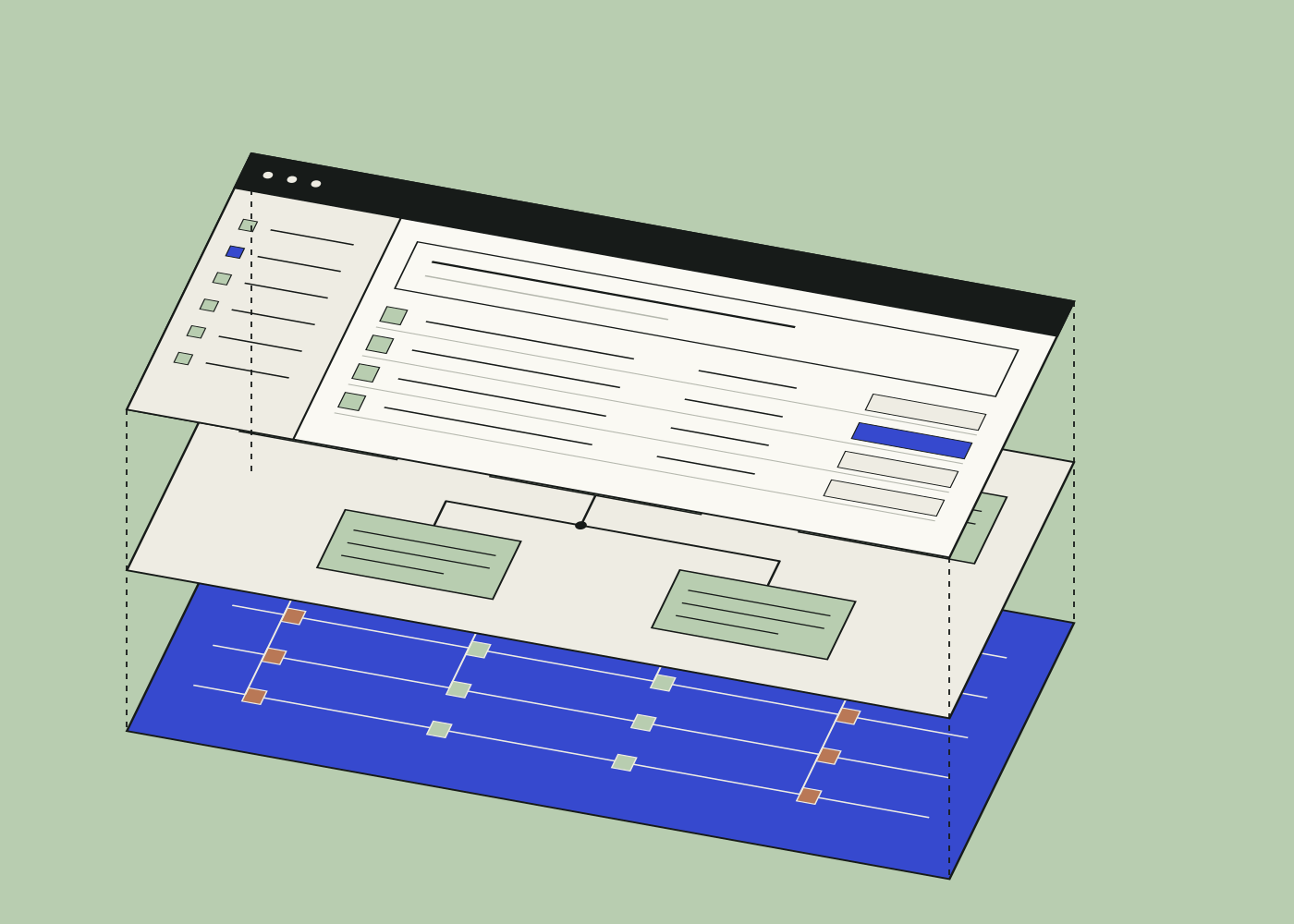
We develop digital twins of assets, systems, processes, and individual collaborators. We connect their information, state, and behavior in models that support operational queries, scenario analysis, and context for the company’s tools and agents.
On this page 06 01
Represent what the decision needs
Scope and correspondence with operations
An operational decision may depend on information distributed across applications, documents, and people. Understanding what would happen after a change in capacity, work sequence, or allocation requires reconstructing those relationships. Llull develops a digital representation of the part of the business being studied and connects it with sources describing how it works. Scope can focus on an asset, a system, a process, or an individual collaborator and extend to their relationships with the wider operation.
Design starts with the questions the twin needs to answer. An asset may require availability and maintenance information; a process, its states, timings, and dependencies; a system, its components and operating conditions. We agree which data must stay current, how often it should be updated, and how its correspondence with operations will be checked. This definition guides the model, data connections, and query interface.
Experience and model uses
For a collaborator’s twin, we work with that person to represent the knowledge, practices, and criteria they use in the agreed activities. We can organize their reference sources, decision examples, and ways of preparing or reviewing work. The person participates in testing and updating that representation. This allows the team to consult their experience and use it in defined tasks, with a clear reference to the sources and the person maintaining the content.
The twin can support scenario exploration, dependency review, or preparation of actions through applications and agents. We develop those functions around the intended use and compare them with known cases. Queries retain information dates and sources; simulations record their assumptions and parameters. Handover includes the model, connections, tests, and instructions for keeping it current as systems, people, or working practices change.
02
A maintained representation, evaluated uses
The project connects part of the operation with its sources, a model, and a set of testable uses. Testing accompanies development and continues as the data or the behavior of the represented subject changes.
Sources and people’s experience inform a representation that can be queried and tested. Usage results and operational changes feed back into the model through reviewed updates.
Connect sources and experience with a model
Connect sources and experience with a model
01 / 02
Swipe or use the arrow keys to explore the diagram.
Agreed uses and reviewSources and provenanceRepresentation and queryOmissions to correct
Connect sources and experience with a model
01
/ 02 ⌄
01
Define the subject and intended use
The keys connect the diagram to this explanation.
Agreed uses and reviewSources and provenanceRepresentation and queryOmissions to correct
G1
AGREED USE AND SOURCES
01
Uses and criteria Detail and updates
02
Data and records
03
Collaborator experience Materials and practices
With the company, we review what the twin needs to help query, compare, or prepare. We identify the assets, systems, processes, or collaborators involved and collect work examples. Scope defines the relationships to represent, required information, and the people who can verify it. We also define the detail and update frequency each use requires, giving development concrete criteria.
Sources can include administrative records, application events, measurements, and materials prepared by collaborators. We review how each contributes to the project’s questions. The design also identifies who knows the information, who can correct it, and how an item requiring an update will be recognized.
02
Build the model and its updates
G2
MODEL AND CURRENT STATE
G3
INITIAL REVIEW
04
Agreed states
05
Relationships and rules
06
Source and date
07
Review owners
08
Initial queries with the team
09
Omissions and refinements
Llull develops the twin’s structure and connects an initial data sample. We incorporate states, relationships, and rules for interpreting the information, together with its provenance and date. When representing a collaborator, we organize materials, examples, and working criteria with that person. Initial queries help identify omissions and refine the model before expanding connections or developing analytical functions.
The representation retains information sources and dates so a query can be interpreted. For a process, that relationship helps identify which task or resource changed. For a collaborator, it makes it possible to return to the material or example supporting a practice. Connections expand after those workflows have been checked with the team.
The twin connects sources, a model, and evaluated uses. Updates and review maintain that correspondence during operation. Current state corresponds to the recorded sources and dates, at the detail and frequency agreed for each use. The enclosure describes the representation of the asset, system, process, or practices agreed with the collaborator. Collaborator experience is incorporated with that person, who participates in definition, testing, and updates. Initial queries allow omissions to be corrected before connections expand.
The same representation supplies queries and the scenario or integration functions included in scope. Each use has its own checks. Results are linked to a version, and changes return to review.
Evaluate each use and review changes
Evaluate each use and review changes
01 / 02
Swipe or use the arrow keys to explore the diagram.
Model and included functionsCases and recordsEvaluation and reviewAgreed use and maintenance
Evaluate each use and review changes
01
/ 02 ⌄
01
Check queries and scenarios
The keys connect the diagram to this explanation.
Model and included functionsCases and recordsEvaluation and reviewAgreed use and maintenance
01
Model and current state
02
Queries Information, source, and date
03
Scenarios Changes, assumptions, and parameters
04
Context for agents Information delivered
05
Evaluation with cases and responsible staff Results by version
06
Operational cases and records
01 · 03
Within scope
01 · 04
If integrated
05 · 01
Refine and retest
We test the queries and scenarios defined for the project. We compare results with operational records and reviews by the people responsible, examining differences and the information explaining them. If the twin includes simulation or AI behavior, we retain assumptions, parameters, and the cases used. Adjustments are reviewed with the same tests to establish what changed and the conditions in which the version can be used.
A query, a simulation, and a function used by an agent can require different checks. We examine retrieved information, the changes assumed by each scenario, and the context provided to the tool. Test records connect results with the model version and help explain what needs correction.
02
Integrate use and maintain the representation
01
Model and current state
05
Evaluation with cases and responsible staff Results by version
06
Operational cases and records
07
Agreed use Interfaces and tasks
08
Sources and review Operational changes
05 · 01
Refine and retest
05 · 07
Following evaluation
08 · 01
Reviewed changes
08 · 06
If tasks are new
We prepare the query interfaces and connections with applications or agents included in scope. We agree who updates sources, who reviews changes, and how differences between the model and operations are handled. Handover includes exercises based on the team’s tasks, documentation, and reusable tests. Changes to a process, system, or collaborator’s practices can be reviewed against that reference before a new version is published.
Follow-up considers both use of the twin and the correspondence of its data with operations. A source change may require a model update; a new task may need additional evaluation cases. This workflow keeps information, the developed capability, and its users’ decisions connected.
The model is the same representation as in the first figure. Scenarios, simulation, AI behavior, and integrations are developed when included in scope; integrations receive context for agreed tasks and reviews. Checks differ by function and retain version-linked results. Refinements return to the model and the same tests. Agreed use can coexist with improvements: a changed source may require an update, and a new task may require additional cases. Changes enter at the agreed frequency and are reviewed before a version is published.
03
Three ways to use the representation
Connected information for decisions
Queries bring together states, relationships, and sources around an operational question. The team can examine the information supporting an answer and the changes that need to enter the model.
Comparable scenarios
Scenarios retain assumptions and conditions so alternatives can be compared. Evaluation supports examining the expected effect of a change and using the results in the corresponding decision.
Context for tools and agents
The twin can provide applications and agents with an up-to-date representation of the business’s resources, relationships, and practices. Integrations use that context in tasks and reviews agreed with the company.
04
Included model, functions, and connections
01
Model and information sources
We define the represented assets, systems, processes, or collaborators, their relationships, and the data needed to describe them. We design how changes enter the model, how versions are retained, and how the date of the information in use is identified.
02
Queries, scenarios, and behavior
We develop the queries and analytical functions included in the project. Where simulation or AI behavior is required, we prepare cases and criteria for comparing results with records and reviews by the people who know the work.
03
Connection with operations
We connect the model with sources, interfaces, and tools according to scope. We define updates, access, tasks that can use the model, and the reviews needed to maintain its correspondence with operations.
A company may need a technical solution before it has the people and knowledge to maintain it. The project combines solution development with defined responsibilities, staff training, and knowledge transfer to the people who will continue operating it.
06
People who know and maintain the representation
Participation in the engagement
The company identifies intended uses, provides agreed sources, and designates the people who know and will review the represented subjects. Collaborators whose knowledge or working practices are incorporated participate in definition, testing, and updates. Llull develops the model, connections, and included functions and organizes evaluation with that team.
Handover and continuity
We deliver the model and its documentation, developed connections and configurations, and evaluation cases with their results. Handover establishes how to query the twin, update its sources, and review new versions. Administration, maintenance, and support responsibilities are agreed around the systems and people continuing the work.